
Best Whole-House Water Filters 2026: Tested for PFAS, Chlorine & Hard Water
Whole-house filters protect every tap, shower, and appliance. Here are the top systems ranked by what they remove, certification, and long-term cost.
Whole-house carbon systems — every tap and shower



A whole-house water filter treats every gallon that enters your home — drinking water, shower water, laundry, ice maker, everything. For homeowners dealing with chloramine odor, PFAS contamination, or elevated THMs, it is the most comprehensive solution available. But the market is cluttered with systems that make big claims without certifications to back them up. Here is what you actually need to know.
What a Whole-House Filter Does — and Doesn't Do
A whole-house carbon filter is excellent at removing disinfection chemicals (chlorine, chloramine), their byproducts (THMs, HAAs), VOCs, sediment, and in some systems, PFAS. It improves water at every tap and dramatically reduces chlorine exposure in showers — which matters because your skin and lungs absorb more chlorine in a 10-minute shower than you drink in a day.
The NSF Certifications That Matter for Whole-House Systems
NSF/ANSI 42 — chlorine taste and odor reduction. The baseline — virtually all whole-house carbon filters have this.
NSF/ANSI 61 — the system's components don't leach contaminants into water. Required for drinking water contact.
WQA Gold Seal — independent validation by the Water Quality Association. The Aquasana Rhino EQ-1000 carries this.
Aquasana Rhino EQ-1000 — Our Top Pick
The Rhino wins on lifespan and PFAS coverage. Rated for 10 years / 1 million gallons — most competing systems need annual filter replacement at $200–300/year. WQA Gold Seal and NSF 42/61 certified. The EQ-1000 reduces PFAS, chloramine, THMs, VOCs, and sediment at every tap. For homeowners in PFAS-affected cities, this is the most comprehensive single-system option.
Check if your city has PFAS violations →
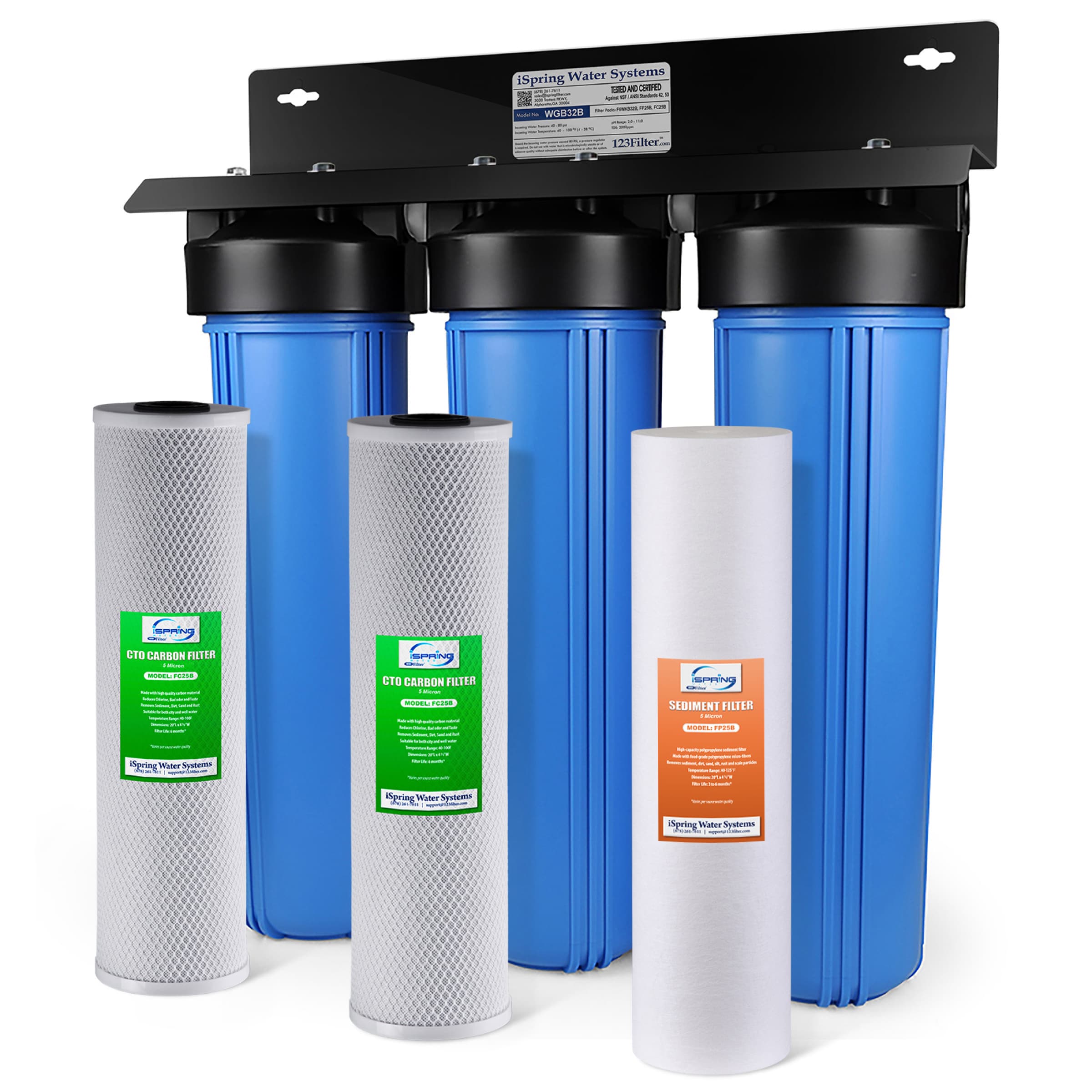
iSpring WGB32B — Best Value Whole-House Entry
About 30% of US public water systems use chloramine instead of chlorine as a disinfectant. Chloramine is harder to remove than chlorine and often needs catalytic or multi-stage carbon. The iSpring WGB32B is a popular DIY whole-house sediment + carbon chain at a lower price point than premium tanks — pair it with an under-sink RO for drinking water if you need PFAS or lead removal at the tap.
Do You Need Whole-House or Just Under-Sink?
Most people overestimate how much they need whole-house filtration. If your only concern is drinking and cooking water quality — PFAS, lead, nitrates — an under-sink RO system costs $375–849 and provides more thorough contaminant removal than any whole-house filter at a fraction of the total cost. Whole-house makes sense when chlorine or chloramine in shower water is a real concern, or when you want consistent filtered water at every faucet.
Check Your Water Before You Buy
The right system depends entirely on what's in your water. Enter your ZIP on WaterCheckup to see your public water system's contaminant profile — PFAS levels, THMs, violations, and contaminant-matched filter recommendations. If you're in a hard water area, see our best hard water filter guide. Or take the 3-question filter quiz and we'll match you to the right system.
Frequently asked questions
What does a whole-house water filter actually remove?
A quality whole-house carbon filter removes chlorine, chloramine, THMs, VOCs, PFAS (in some systems), sediment, and heavy metals at every tap and shower. It does NOT soften hard water or remove nitrates — those require different systems. Check the specific NSF certifications of any system you consider.
Do whole-house water filters remove PFAS?
Some do. The Aquasana Rhino EQ-1000 is certified to reduce PFAS at the whole-house level. Most basic carbon filters are not. Look for NSF/ANSI 58 or specific PFAS reduction claims on the product listing.
How long do whole-house water filters last?
Entry-level systems need filter replacement every 3–6 months. Premium systems like the Aquasana Rhino advertise 10 years / 1 million gallons. Actual life depends on water quality and household usage. Higher sediment levels shorten filter life.
Is a whole-house filter worth it?
For homeowners in cities with chloramine treatment, PFAS contamination, or elevated THMs, a whole-house system protects your skin and lungs from chlorine in showers — not just your drinking water. For PFAS specifically, a drinking water RO under the sink is often the better targeted investment.
What is the difference between a water filter and a water softener?
A water filter removes contaminants. A water softener removes hardness (calcium and magnesium) through ion exchange. They serve different purposes. If you have both hard water and contamination concerns, you may need both — a softener for scale protection and a whole-house filter (or under-sink RO) for contaminant removal.
Match a certified filter to your water source, concern, and home situation.
Live EPA data, PFAS results, and violation history for your ZIP — free.
Check My Water Free →